
B4 The Lost City
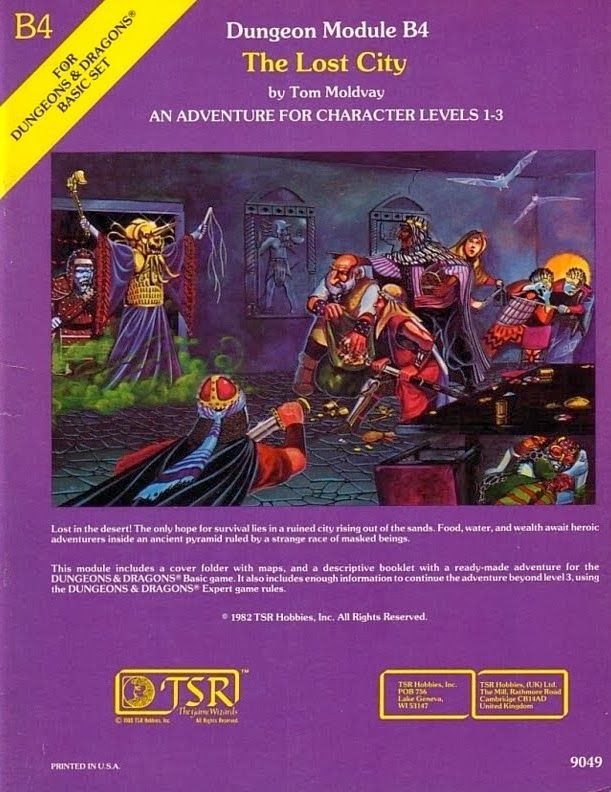
B4: The Lost City by Tom Moldvay is, without question, my favorite and most played Dungeons & Dragons module. Though originally designed for Basic D&D, I’ve run AD&D campaigns in it, used it for Fantasy Hero, and even shoehorned it into a Gamma World session. It’s a near-perfect example of a lean, sandbox-style campaign with excellent pacing.
The game begins atop a buried pyramid, each level revealing more of the world, its dangers, and its mysteries. As the players descend, their world literally expands—both in scale and in their understanding of the story. Eventually, they emerge into a vast underground city, where the alien horror Zargon looms over the remnants of a lost civilization. It feels like something pulled straight from the pages of classic pulp—Stephen Merritt’s The Moon Pool, Howard’s Red Nails, and any number of lost-world tales.
Brian Eno once said, “The most important thing in a piece of music is to seduce people to the point where they start searching.” The Lost City does exactly that. Its hook is irresistible—once players take the bait, they’re drawn deeper and deeper into its mysteries. Unlike “funhouse” dungeons where random monsters mill about in rooms for no reason, The Lost City has an internal logic. The Cynidiceans—its bizarre, degenerate inhabitants—have a genuine plight, complete with factional conflicts that pull players into something far more engaging than the usual murder-hobo rampage.
In just 28 pages, it gives you everything you need to get started while leaving enough gaps for a Game Master to make it their own. I’ve always found that with adventure modules, less is more. Goodman Games released an expanded version in 2020, which I was very excited to buy—and very disappointed to read. Not because it was bad, but because it wasn’t my version of The Lost City. It went in directions I never would’ve chosen. Again, Less is so often more when it comes to gaming supplements.